
No CS2 case is a profitable open on average. On 10 October 2026, all 42 cases in our case ROI tool had an expected value below the price of the case plus a key, from about −39% to −75%. Open a case for the skins you want at a cost you accept, sell it if you want the balance, and hold it only with a reason to expect demand. The best CS2 cases ranking shows today’s order.
Open, sell or hold: what are you after?
| Goal | Compare | What it means |
|---|---|---|
| A specific skin or knife | Buying it directly against the cost of opening | Buying gets you exactly that item. |
| The opening itself | Case + key against the expected value | Set a budget for the average loss. |
| Spending balance | What the unopened case sells for after fees | Opening gives up that sale too. |
| A long hold | Where new copies come from and who will open them later | Write down why the price should rise. |
How to read expected value in the case ROI tool
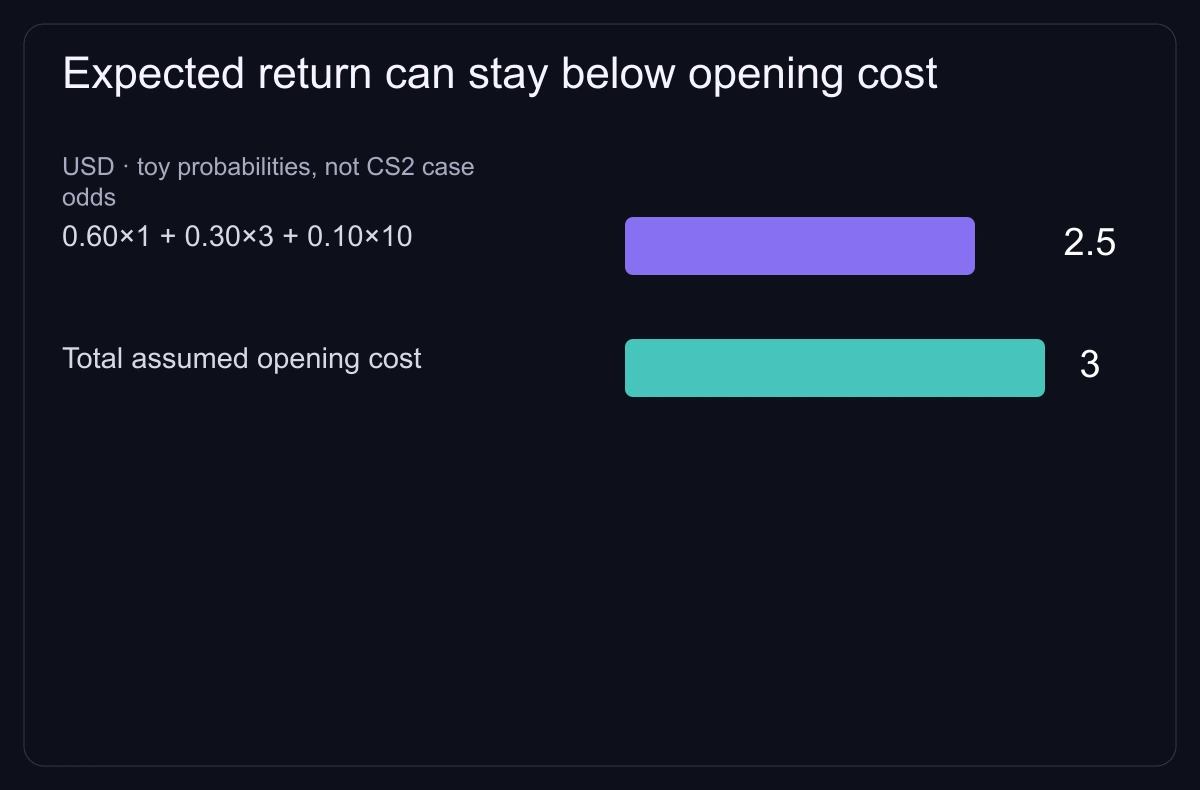
Expected value is the average value of everything a case can drop, weighted by the chance of each drop. ROI compares it with the case price plus a key: −40% means you get back $0.60 for every $1 on average. That is an average over many openings; one opening drops one item. The tool prices drops before selling fees and uses a key price of $2.49, or a lower key price from our price data when there is one. Each case’s possible drops and their prices are listed on its card.
A dropped case still costs something to open
Example: a case you got as a drop sells for $1 after fees, and a key costs $2.49. Opening it gives up $3.49: the $1 you could have sold it for plus the key.
Holding cases: supply and demand
Supply: how do new copies reach players today? Check the game and Valve’s announcements rather than an old list; a case that stops dropping one way can still enter inventories another way.
Demand: someone has to want to open the case later at a higher price than today. Compare its contents with newer cases that offer similar finishes. Valve’s 22 October 2025 update added five-Covert knife and glove trade-ups, which gives Covert skins another use; that alone does not make a case’s price rise.
Selling cases in bulk
Example: 100 cases bought at $0.80 cost $80. Sold at $1 each on a marketplace that takes 8%, they return 100 × $1 × 0.92 = $92, a $12 profit. Break-even is about $0.87 per case.
If buyers take only 20 at $1 and the other 80 sell at $0.85, the sale brings $88 before fees and $80.96 after: the profit drops to $0.96. One listing at $1 does not price 100 cases. On cheap items, the Steam fee’s $0.01 minimum also takes a bigger share; the fees guide has the details.
Write down when you would sell
Note the case, quantity, cost, why you hold it, where you would sell it, and the price or event that ends the idea. The investment calculator keeps quantities and purchase prices and values them at current prices.