
The best CS2 maps for beginners are Mirage and Dust II. Both are Active Duty maps, so you meet them in Premier, and both have an official starter map guide you can load from the pause menu (Valve, 18 March 2026). Pick the one your friends can explain, learn one CT position and one T route, then add a second map.
Choose by the skill you want to learn
| Map | Useful first lesson | Beginner trap |
|---|---|---|
| Mirage | How mid connects attacks on both sites | Dry peeking window and assuming mid stays cleared |
| Dust II | Long sightlines, pre-aim and trading through a choke | Turning every round into the same unflashed rush |
| Cache | How three lanes split the defense | Forgetting mid once it has been checked |
| Inferno | Space gained with timed utility | Bunching up in banana and throwing every grenade at once |
| Nuke | Vertical routes and precise information | Confusing upper, lower and the route an enemy used |
Cache came back on 28 April 2026, and Valve says new players can quickly learn this classic three-lane map (The Return of Cache). It replaced Overpass in the Active Duty pool when Season Five began on 8 July 2026 (Season Five notes).
Valve sorted the maps into three groups at CS2's launch: touchstone maps such as Dust II kept their CS:GO layout, upgrade maps such as Nuke got new lighting and materials, and full-overhaul maps were rebuilt from the ground up (CS2 overview).
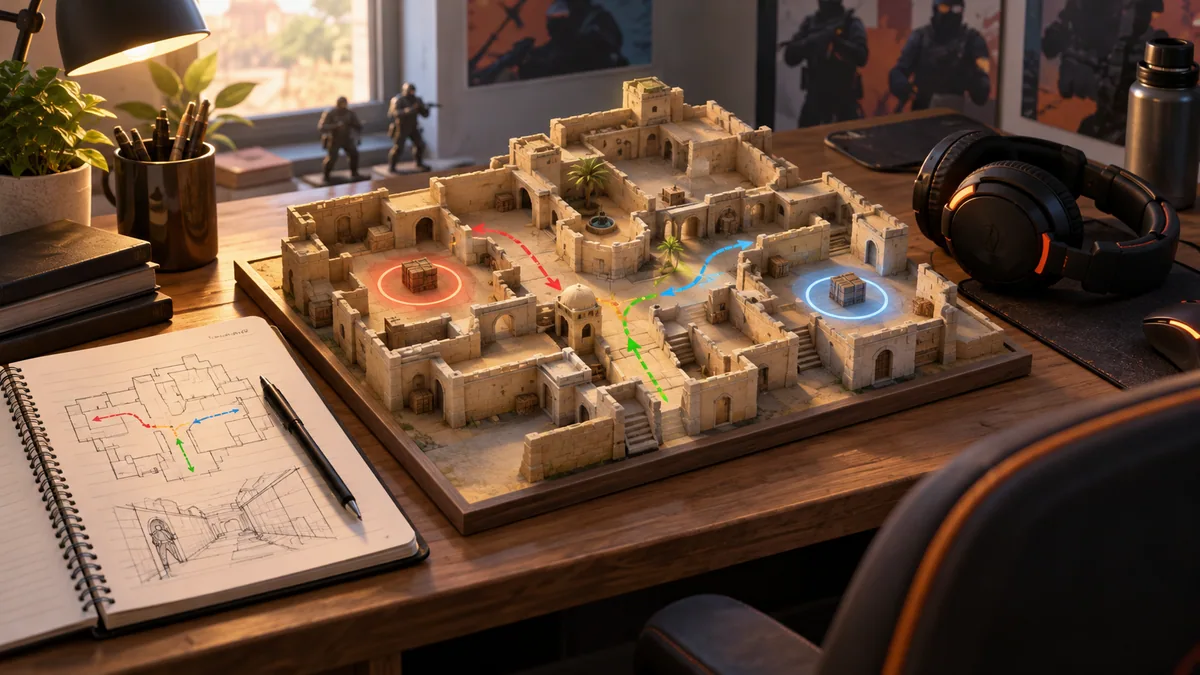
Your first map walk
- Launch the map in Practice and walk from each spawn to both sites with the radar open. Load the official map guide if you want marked spots.
- Pick one role, such as B defender. Find first contact, the nearest cover, your retreat and the route teammates use to help.
- Learn the names of six nearby positions, each tied to a landmark you can see.
- Follow one T entry route. Stop before each angle, pre-aim where a head would be and notice where a second angle opens.
- Throw one delaying grenade and one support flash, then look at the result from both sides.
Callouts vary between groups. “Kitchen” and “market,” or “main” and a site entrance, may not mean the same thing to everyone, so agree on names before contact. A useful call gives place, count and direction: “two B apps, moving out.” The story of how you died can wait.
Play with a small learning target
For your first matches, choose one goal, such as surviving long enough to call the first B contact. Do not try to learn every smoke and rotation at once. After a confusing death, write down where the enemy appeared, which route you did not check and what information was missing.
Example: you die from short while staring at Mirage apartments. The fix is not more apartments positions; it is knowing when your short player leaves, what that call means and how to change your hold. The Mirage guide covers that relationship.
When to add the next map
Add a map when you can explain your common deaths, buy for your role and reach both sites without guessing. There is no fixed deadline. If you know your home map but still never call, a new map will not fix the missing habit.
Competitive lets you choose the map you are learning. Premier's four-map pick can still hand you a map outside your favorite pair, so learn a fallback role on the rest of the pool before you queue. Try Nuke next for layered routes, or Inferno banana for coordinated utility.