
The key beginner check is whether a purchase still makes sense at a realistic price after fees when you sell. Before you buy, know the exact item, who will buy it from you and every cost on the way out. A rare item or a rising chart doesn’t answer those questions.
Each mistake below comes with a check you can run in a few minutes.
Mistake 1: treating a chart gain as profit
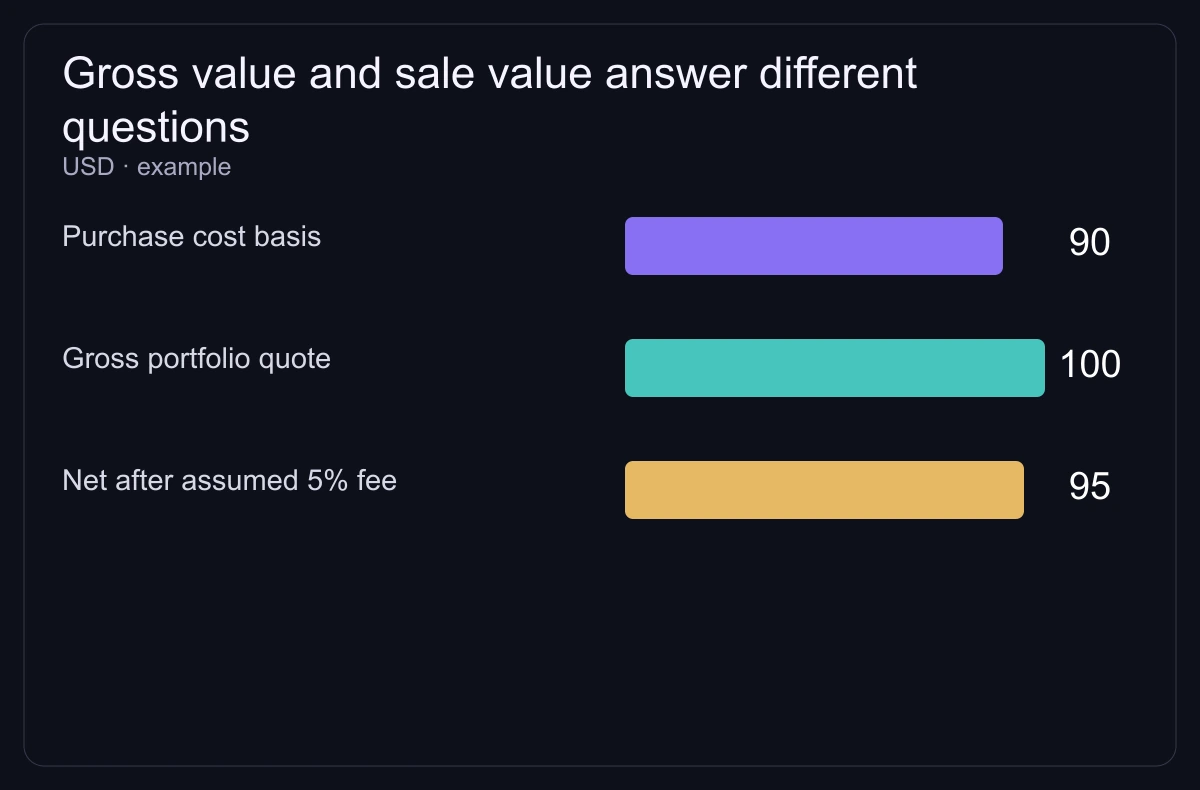
Example: you buy for $100 and sell for $110 with an 8% selling fee and a $2 withdrawal charge. You receive $110 × 0.92 − $2 = $99.20, so a 10% price rise still leaves a $0.80 loss. Break-even is ($100 + $2) / 0.92 ≈ $110.87.
The check: calculate what actually reaches you after selling, withdrawal and currency fees. On Steam, use the seller-proceeds preview instead of subtracting a percentage from the wrong price. The fee guide covers Steam Wallet versus cash and fees charged one after another.
Mistake 2: pricing ten items from one sale
Example: you buy ten skins at $20 each. One buyer pays $25 for one, but the other nine sell at $19. Gross proceeds are $25 + 9 × $19 = $196, already below the $200 you paid, before any fees.
The check: look at buy orders, recent sales and competing listings for your quantity on the marketplace where you will sell. For a special float, seed or craft, compare the same attributes. Keep buy orders, completed sales and unsold listings apart in your notes.
Mistake 3: trusting an incomplete total
Our investment calculator shows value before fees. A holding with no current price counts as $0 in the total while its purchase cost stays in, which shows a loss that isn’t real. Fill the gaps before you read the total.
The same goes for contracts: in our trade up calculator, make sure every input and result has a price before you trust a positive EV (the calculator flags anything unpriced), and compare EV before and after the seller fee of the market where you would sell. Here is how we calculate prices and odds.
Mistake 4: calling several categories diversification
Cases, knives and stickers have different buyers, but all of them depend on one game and one platform, so a single Valve update can affect all of them. Valve’s 22 October 2025 update let five Covert skins trade up into a knife or gloves and changed what several item types were used for in one patch.
Set the loss you could absorb before you shop. Example: a $60 loss budget with a planned 30% drop gives a $200 position limit. If the drop is bigger, you lose more than $60. If you plan for a total loss, the limit is $60.
Mistake 5: rewriting the story after each bad day
Write down why you bought and what would prove you wrong. “The supply source closes and repeat buyers stay active” can be checked; “it will go up eventually” can’t. Keep the original note so a later price update doesn’t rewrite your reasons.
A review date is when you re-check the idea, not a deadline to sell at any price. If you will need the money soon, the chance of a slow or discounted exit matters before you buy.
A five-step fix
- Pin down the exact item and its attributes.
- Save dated buy and sell prices from the same type of source.
- Calculate a normal and a worse exit after fees, for your full quantity.
- Fill missing prices and mark any premium you haven’t confirmed with sales.
- Write down the most you can afford to lose and what would change your decision.
For the full research routine, continue with the CS2 skin investment guide.