
A Blue Gem is a Case Hardened skin whose pattern shows mostly blue on the side you see in game. Its price depends on the exact weapon and paint seed, so check the seed first, inspect the actual item, then price the premium from sales of the same or a similar seed. A seller’s “Tier 1” label is where your research starts.
For a first collector buy, pick a look you enjoy at a price you can hold without needing to resell. Rare patterns sell to a small group of specialist buyers, and the ordinary Case Hardened price says little about what they pay.
Finish, seed and float are three different things
The finish makes the item Case Hardened. The seed sets where the pattern lands on that weapon. Float sets the wear. A clean item is not automatically a blue one: a low float will not turn a gold-heavy seed into a Blue Gem. The same seed number also looks different on an AK-47 and on a Karambit.
Valve’s Weapon Finishes Guide explains that every finish is applied with random offsets and rotations, so no two wear patterns are identical. Blue Gem tiers come from the trading community, not from Valve.
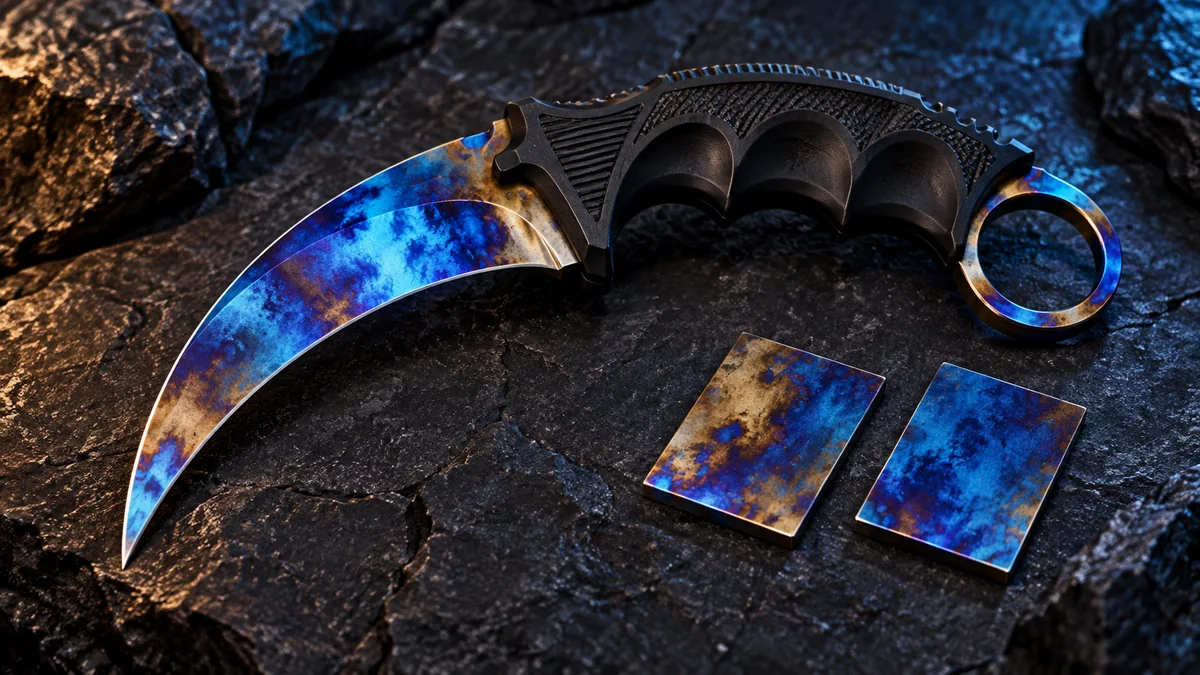
Look up the seed
- Get the paint seed of the exact listing and match the weapon, wear and normal or StatTrak™ status.
- Open our Blue Gem pattern lookup, pick the same weapon and enter the seed. It covers 23 weapons, from the AK-47 to the Shadow Daggers.
- Read the community tier. The top seeds in the lookup are AK-47 #661 and Karambit #387.
- Inspect both sides, the blade tip or receiver, and the worn edges in normal game lighting. Save screenshots a buyer can reproduce.
- Inspect again right before you pay, especially if the seller changes the listing or the trade.
The lookup lists tiers, not prices. A seed missing from the list is simply unranked, and a record sale mentioned on the page is history, not today’s price.
Compare like with like
| Match first | Then compare | Don’t substitute |
|---|---|---|
| Weapon, finish and seed | Play-side layout and breaks in the blue | A similar blue on another weapon |
| Wear and quality | Exact float, scratches and edges | A Factory New record sale for a worn normal item |
| Sale type and date | Completed sale, buy order or unsold listing | A rumoured private sale |
The price table gives the ordinary price for the market name; it can’t separate your seed’s premium. Search the marketplace where you plan to sell for the same or a close seed, and keep completed sales apart from asking prices. If your nearest match has a different seed, write down why a buyer would pay the same for yours.
Even a resellable premium can lose money
Example: the plain version of the skin costs $200 and the seller wants $500 for the pattern, a $300 premium. You expect a buyer at $550 and pay an 8% selling fee. You receive $550 × 0.92 = $506, only $6 more than you paid.
If the buyer pays $450, you get $414 and lose $86. Break-even is $500 / 0.92 ≈ $543.48. A small change in the premium wipes out the margin, so “the next tier costs more” is not a reason to buy on its own.
When to skip the listing
Skip a resale buy when the inspect link doesn’t match the offered item, when the premium rests on someone else’s record sale, or when you can’t name a buyer at your price. For a personal collection, paying a premium you can’t resell is fine as long as you count it as spending.
Never send an item to a stranger for a “pattern check”: inspecting is enough, and a transfer is a separate risk. Follow the trade confirmation steps before an expensive exchange.