
To play the AWP well in CS2, buy it for a specific job, hold an angle you can escape from, and treat every second peek as a new decision. Pick the line, the escape route and your response to a miss before you peek. If the purchase leaves the rest of the team without equipment, a cheaper weapon can make a stronger round.
Three questions before you buy
- Can the team still afford the armor, rifles and utility its plan needs?
- Which opening pick or hold suits the AWP this round?
- If you are pressured, who flashes, trades or picks the weapon back up?
Read the current buy-menu price and your team's equipment instead of following “always buy after winning the pistol round.” A force-buy AWP is a deliberate exception that needs a team plan, not something that is always wrong or always right.
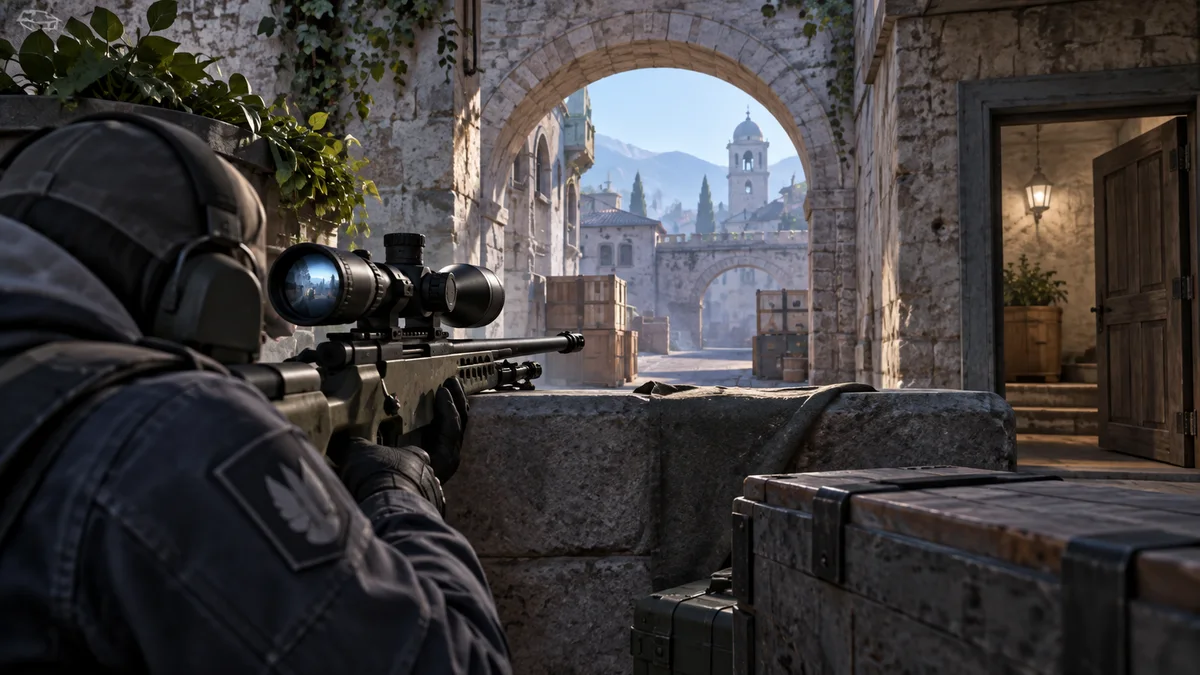
Hold a shot you can survive
Pre-aim at chest height: the body is a bigger target than the head, and a scoped flick to the head is harder to land. This is different from rifle training, where first-bullet head height matters most.
Stop before you fire. Put your crosshair where the enemy will cross rather than glued to the corner, and leave room for their speed and angle. Too tight forces a big correction; too wide can miss a careful peek. Compare both on the same angle in practice.
Have cover you can reach after the shot. A fixed, exposed position is easy to flash, burn or trade. An off-angle buys surprise, but once the surprise is gone without an escape route, the position loses its value.
The second peek is a new decision
| After the first contact | Reasonable response | Why |
|---|---|---|
| Miss, and the enemy knows your spot | Fall back, change position or ask for a flash | The next peek meets a prepared crosshair. |
| Kill, and another player can trade you | Use cover and call the advantage | Keeping the advantage can be worth more than a second shot. |
| Enemy must cross before time runs out | Hold or re-peek with support | Backing off can give away the round's objective. |
| Close rush with no escape | Use your pistol and nearby support | A pistol is practical; a flashy no-scope is not a plan. |
“One shot, then always run” is too rigid. After each shot, reassess what the enemy knows, your cover, your teammates' positions and the objective. Call information even when you miss.
Movement, sound and the scope
A quick scope animation is not the same as a good stop. Practice stop, scope and shot at a calm pace. Keep the AWP ready when contact is likely; switching to the knife by habit leaves a window where you cannot answer.
Unscoping is silent since 22 September 2026: Valve's update notes say un-scoping a sniper weapon no longer produces a sound (update notes). Old advice that every unscope gives your position away is out of date; your footsteps and shots still make noise.
A drill that tests more than flicks
Pick one held angle and do ten repetitions: stop, find a body target, fire and reach cover. Count accurate stationary shots and successful retreats separately. Then have a partner vary the peek speed or use a moving target. A good static score alone will not show whether you can handle a trade pack.
In deathmatch, practice choosing a line with an escape and dropping automatic dry re-peeks. In a demo, review your choices after two misses and two kills. Did the AWP create a useful advantage, or just collect kills on players who were already leaving?
Whether to save depends on time, kit access, support and the score, not just a 2v4 label. Call the save early if keeping the gun makes the next buy stronger. Use economy planning and movement practice to support the role.