
A good CS2 practice routine warms up a familiar skill before ranked and trains one new fix in a separate block, then checks in later matches whether it changed. Pick the error from your last matches, drill it under stable conditions and count it again. Leave room for the full match: Valve set Premier and Competitive to at most 24 rounds in regulation, with a 6-round overtime for a tie (announcement, 31 August 2023).
Choose the task before the timer
- Warmup: make familiar movements comfortable. Stop when you feel ready, before chasing a personal best.
- Practice: isolate one error, get feedback and repeat the corrected action. Expect to slow down.
- Match: apply one cue while still playing for the team's objective.
- Review: check real situations, not a general feeling about your aim.
With only 30 minutes free, do a drill and a review or a short mode instead of ranked. With enough uninterrupted time, warm up briefly, finish the match and review afterwards.
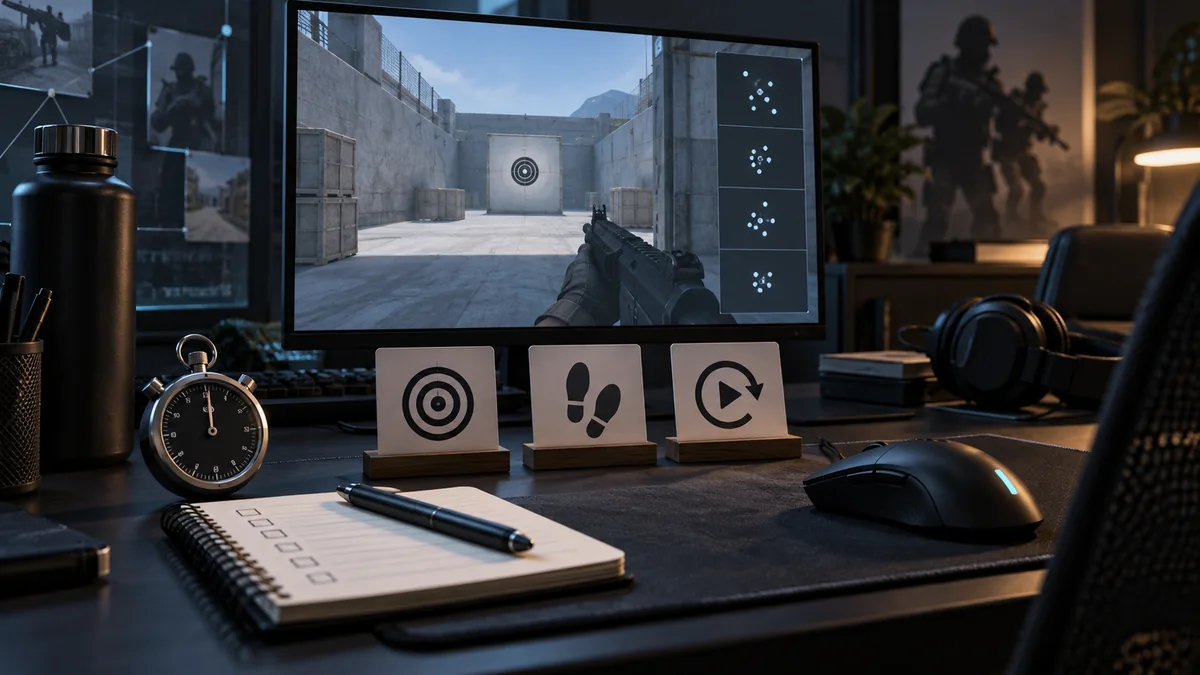
Three schedules you can adapt
| Session | Example split (minutes) | Output |
|---|---|---|
| 20 minutes, no ranked | 3 warmup, 10 focused drill, 5 deathmatch or route test, 2 notes | One measured task and the next check |
| Match session | 5–10 familiar warmup, the full match, 5 review | One cue applied under pressure |
| Review session | 10 on three relevant rounds, 10 corrective drill | A specific action that replaces the mistake |
Adjust the times to your energy and schedule. A warmup should not tire your hand before the first real duel.
Turn an error into a trainable action
Example: you dry re-peek a known AWP in four of six reviewed situations. The action is “after contact, use cover and ask for a flash.” Practice the route with a partner, then count the same situation in later matches. If it happens in two of five next time, the error rate moved from 4/6 (about 67%) to 2/5 (40%). Five situations is a small sample, so keep counting before you call it fixed.
For mechanical errors, keep conditions fixed. Use recoil practice for short groups, movement practice for post-stop shots and utility practice for timing. Do not pick five unrelated fixes at once.
What the browser tools measure
The click trainer shows appearing targets and reports hits plus your last, best and average hit times. That time includes finding the target and moving to it, so it is not a pure CS2 reaction test, and it has no recoil, match import or rank prediction.
The reaction test asks you to wait for the go signal, flags early clicks and shows your latest result and session best. Your display, browser and mouse add delay to both tools, so compare scores only on the same setup and use them as a light warmup, never to judge CS2's netcode.
A weekly loop with a clear stopping rule
Choose one focus from a demo. Practice it two or three times, review another match, and keep or change the drill based on the situations you counted. Note map and role so a different context does not pass for improvement.
Stop when discomfort, fatigue, a repeating technical problem or rushed calls make the work useless. A break after two losses can be a sensible personal rule. If the session ends early, a short note is enough.
Keep the log to four fields: problem, action, situations checked, next test. Rating is a delayed result of many matches; it is not the only measure of whether this one habit changed.